

The Version-Control Problem No One Owns


Every finance team has a version of the same file: *Q3_financials_v3_FINAL_updated.xlsx*. It’s funny, right up until it’s the file that made it into the board pack, and it turns out it wasn’t actually the final version.
“Which file is the real one” sounds like an annoyance. It’s actually a control failure wearing an annoyance’s clothes, and when it goes wrong, the controller’s name is the one attached to it.
The everyday symptoms
None of this will be unfamiliar:
- A broken link in a workbook that quietly stops pulling from the source it’s supposed to reference.
- Version sprawl: three or four files circulating for the same report, each slightly different, none clearly authoritative.
- A last-minute figure that got fixed in one copy and never made it into the copy that actually got sent out.
- A workbook that “only works” if you open it in the right order, or ask the one person who remembers how it’s built.
Individually, each of these looks like a minor annoyance. Together, they describe a reporting environment where nobody can say with confidence which file is correct at any given moment. A broader look at audit friction lists the same pattern almost verbatim as one of five recurring symptoms of a close that isn’t producing repeatable evidence: “version confusion about which file is final,” sitting right alongside “one spreadsheet that only one person understands.”
What it actually is
Reframed honestly, this isn’t a filing problem. It’s a control and audit-trail risk. As one recent look at Excel risk put it, the real danger isn’t Excel itself, it’s disconnection: “files multiply. Versions drift. Naming conventions like ‘final,’ ‘final v2,’ and ‘final v7’ quietly replace governance.” At that point, version-numbering has become the control, an informal, unenforced one that depends entirely on everyone remembering to follow it, every time, under deadline pressure.
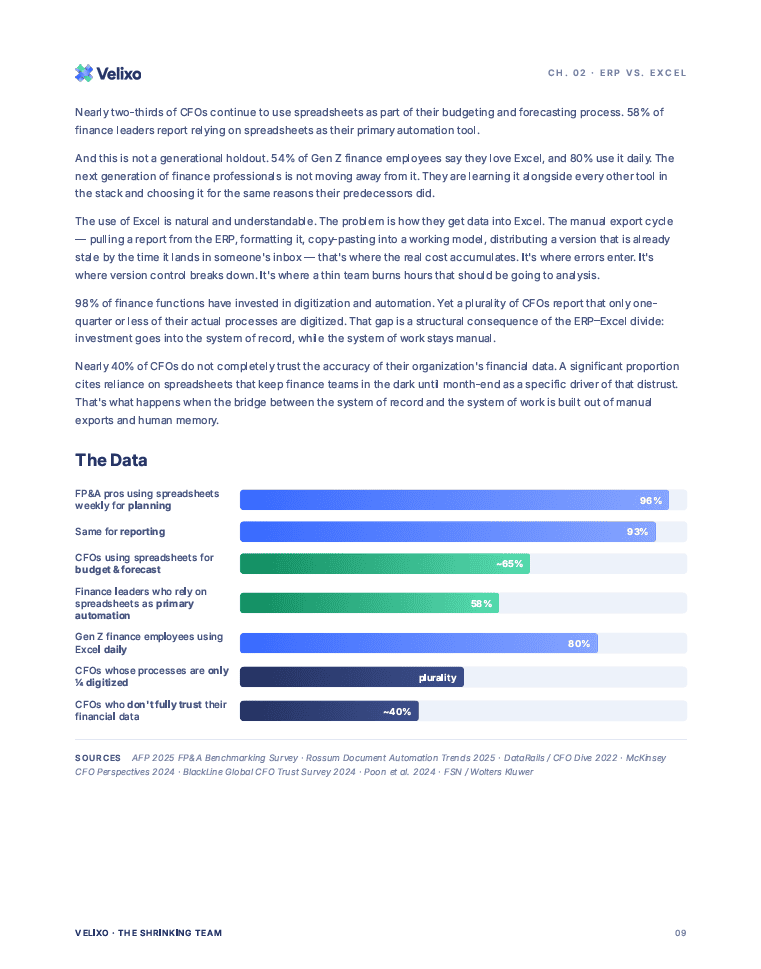
It’s worth being precise about where the blame actually sits. Excel itself isn’t the problem. A separate look at Excel’s staying power in finance points out that 86% of financial professionals still rely on it for budgeting and forecasting, and roughly 90% of organizations still run critical finance processes on spreadsheets. The same piece names the exact failure mode this brief is about: workbooks that get “copied, emailed, and dropped into shared folders,” with “each stakeholder adding their own tweaks,” until “finance and IT are spending days reconciling which version is ‘real.'” That’s not a tool problem. It’s an ownership problem that happens to show up inside a spreadsheet.
The failure mode is specific and recognizable: a wrong number reaches leadership because two files disagreed, and nobody caught it before it went out the door. It doesn’t take a dramatic error. It takes one adjustment made in the wrong copy, and one person who didn’t know there was a wrong copy to worry about.
Why it’s worse than it looks
The same account of Excel risk describes exactly how this compounds over time. A late journal entry lands, the ERP gets updated, but the spreadsheet doesn’t, so “someone manually fixes a number to ‘make it tie.'” Eventually, there’s a workbook that only one person feels safe touching. Not because everyone else is incapable. It’s because the logic inside it is fragile and undocumented, and touching it wrong could break something no one would notice until much later.
That single point of dependency is itself a risk. What happens to that reporting process the week that person is out, or leaves the company?
Auditors, for what it’s worth, aren’t actually afraid of Excel. A panel of auditors and finance leaders made this point directly: “auditors are NOT against Excel… the issue is uncontrolled and disconnected spreadsheets.” Heavy copy-paste, hard-coded numbers, and files that can’t be refreshed consistently. Version confusion is one of the fastest ways to turn “familiar tool” into exactly that kind of red flag.
Who owns this, actually?
Ask most finance teams who’s responsible for version integrity, who decides which file is the source of truth, who verifies it before it goes out, who retires old copies, and the honest answer is usually: no one. It’s assumed to just work, right up until it doesn’t.
That’s the question worth sitting with, independent of any fix: if a wrong number went out tomorrow because two files disagreed, who would have caught it, and how?
See the Hidden Control Risk + Download Free Guide
 |
 |
Reading about the problem is one thing. Seeing it mapped to your own team is more useful. We built a free Lean Finance Self-Assessment for exactly that, a quick diagnostic that pinpoints where your close, your reporting, and your team’s time are quietly bleeding capacity.