

From horse to hands-off: the 5 levels of AI maturity

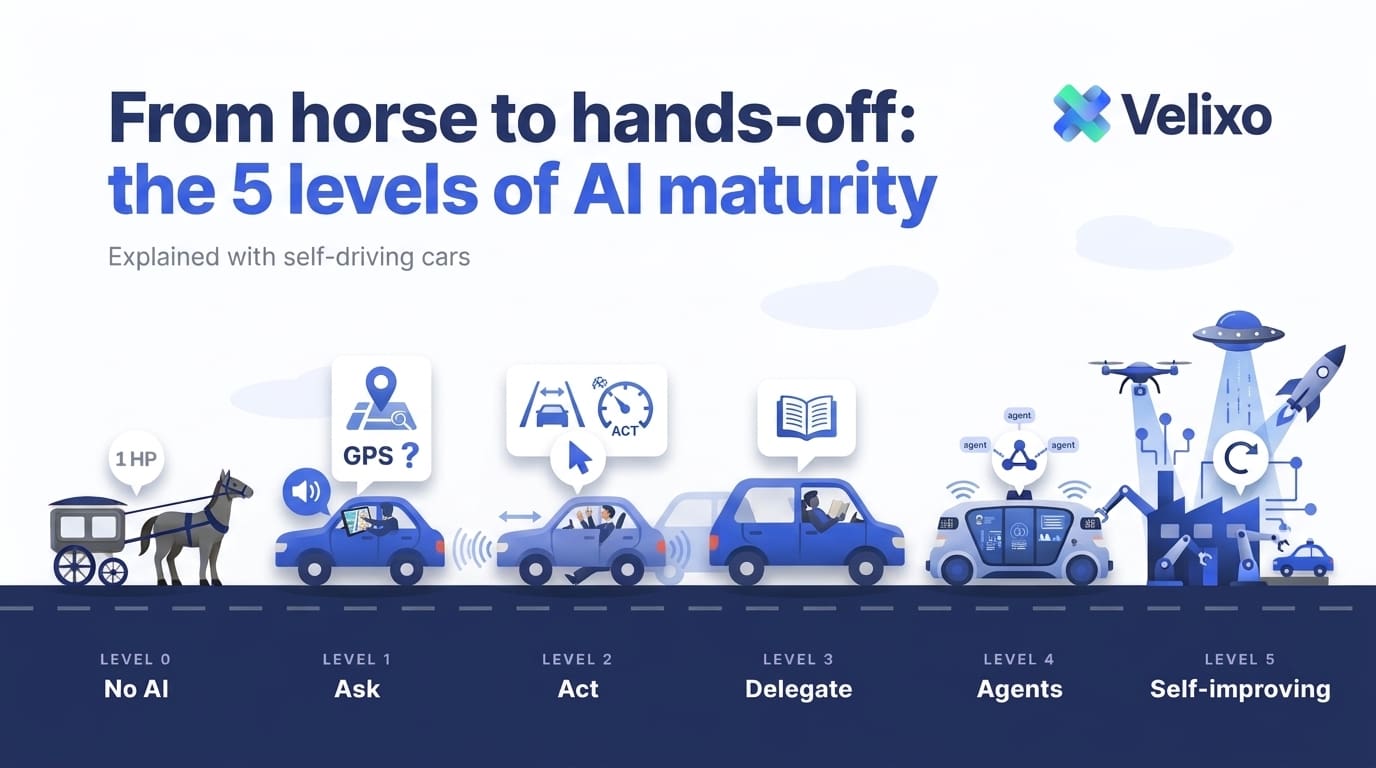
Ask any executive whether their company uses AI and the answer is yes. Ask what it does for them, and most describe a better search engine.
I have spent the last two weeks in front of partners and customers in North America, Australia and New Zealand, and I keep coming back to the same picture: AI adoption has levels, and they line up with the levels of self-driving cars.
The car industry uses a scale from SAE International that runs from Level 0, no automation, to Level 5, a car that drives itself anywhere. The scale is less about how clever the car is than about one question: who is watching the road? That is the right question for AI too.

(Level 0 is the horse and carriage: the company that has blocked AI altogether, while its employees photograph their screens with their phones and use it anyway. In fairness, the horse knows the way home, never needs a software update, and has never once hallucinated.)

Level 1: Ask
This is where most people are. You open ChatGPT, ask a question, read the answer, and then do the work yourself.
I call it Google on steroids, and the data agrees. In OpenAI’s study of how people use ChatGPT, about half of all messages are people asking for information or advice, and the researchers describe information-seeking as a close substitute for web search.
It is useful. Asking your ERP for sales by customer in plain English beats building a report. But it is cruise control. The car holds the speed, and you are still driving.
Level 2: Act
At Level 2 the AI stops telling you what to do and does it. It drives your browser, fills in the form, writes the document, creates the sales order in your ERP.
In my demos I ask for my top three customers, then tell the agent to add a note to each of their records in Acumatica. I photograph a receipt and it creates the expense claim, with the date, amount and category filled in.
This is a car that steers and brakes while your eyes stay on the road. You confirm every action. Productivity jumps because you can run two or three conversations at once, but you are still the bottleneck: nothing happens unless you are sitting there.
Level 3: Delegate
Level 3 is where you stop watching. In driving, the big line sits between Level 2 and Level 3: responsibility for monitoring the road moves from the driver to the system. With AI it is the same line, and most companies have not crossed it.
You cross it with scheduled and background tasks, in tools like Claude’s scheduled tasks (what started as Cowork). Every Friday at 4 pm, an agent reads my Outlook calendar, matches each meeting to a customer and project, and prepares my timesheet. It took 15 minutes to set up. I review the result, not the steps.
The same pattern covers a daily receivables summary posted to Teams, or an agent that watches the sales inbox and turns emailed orders into sales orders. Three customers asked me for that last one in a single week.
My favourite example is the wholesaler whose container is delayed at sea. Today someone reads the supplier’s email, finds the purchase order, updates it, updates every customer order behind it, and emails the customers. A delegated agent does all of that, then orders cookies for your top five customers with an apology note.
A Level 3 driver must take the wheel when the car asks. A Level 3 manager must be able to see what the agent did, why, and undo it. The ship date can be reversed. The cookies are non-refundable.
Level 4: Autonomous agents
At Level 4 your prompt stops being a task and becomes a goal: grow this business. Agents research the upsell opportunities, source the product, run the marketing, and hire more agents when they need help.
It works like a company. A CEO has direct reports, who have teams of their own, and all of it runs inside a budget. One partner told me last week that they already run nine autonomous agents arranged as an org chart, with one person overseeing them.
The budget is the geofence. A robotaxi needs no driver, but only inside its service area. A Level 4 agent needs no supervisor, but only inside the spending limit and permissions you set. The plumbing is arriving: banks now issue cards to agents with limits the agent cannot raise.
Your job changes from doing the work to herding the agents. You set direction, watch the outcomes, and step in when one wanders off.
It also breaks today’s controls. Dozens of agents making hundreds of ERP changes a day cannot be governed with an audit trail that says what changed but never why. I think mass adoption is a few years away, and governance is what decides how many.
Level 5: Recursive self-improvement
Recursive self-improvement, or RSI, means an AI system that can design, build and train its own successor without people in the loop. The successor is better at that job, so it builds a better one again, and the loop feeds itself.
Nobody is there. Only the frontier labs are close enough to measure the distance. Anthropic reports that Claude wrote more than 80% of the code merged into its own codebase as of May 2026, and that the length of task AI can finish reliably has been doubling about every four months. It also says plainly that it has not reached RSI, that RSI is not inevitable, and that people still choose the direction.
This is where the car analogy bends. A Level 5 car drives anywhere, but it does not design the next car. RSI is the factory that redesigns itself.
The stakes rise with it. A small flaw can compound from one generation to the next, and the pace can outrun the people and institutions meant to oversee it. That is why the labs are talking to regulators now.
For the rest of us, Level 5 is not a goal for next quarter. It is the reason the first four levels keep getting easier to reach.
The bottleneck moves
From Level 3 up, the hard part is no longer getting the work done. It is supervising it. The tools we rely on to manage code, teams and projects were built for the pace of people, not for the volume of work agents produce.
Anthropic is the clearest example. Between May and September its daily count of merged code changes grew twelvefold, past 30,000. Git could not keep up, so the company built its own source control system from scratch.
We saw a smaller version of this at Velixo. AI made our development much faster, and the bottleneck simply moved downstream: to code review, then QA, then documentation, then to marketing and enablement keeping up with what ships.
So we built our own AI-enabled dashboard to watch our development agents. Think of a shepherd. He does not walk each sheep to the pasture. He stands where he can see the whole flock, counts heads at the gate, and sends the dog after the one heading for the cliff. The dashboard is our hilltop and our dog, and we are building the same kind of tools for our customers.
Where are you on the road?
Most companies are at Level 1 and believe they are at Level 3.
You cannot skip levels. Nobody hands the keys to a car that has never stayed in its lane, and nobody should hand a budget to an agent that has never posted a clean transaction under supervision. Each level is earned with the same three things: permissions the agent cannot exceed, a record of what it did and why, and a way to undo it.
You also cannot delegate a process you cannot describe. The companies that move fastest will not be the ones with the most agents. They will be the ones that know their own processes well enough to hand them over.
So: which level are you at today, and what would it take to move up one?
Sources
- SAE J3016: Levels of Driving Automation, SAE International
- Path to Autonomy: Self-Driving Car Levels 0 to 5 Explained, Car and Driver
- How people are using ChatGPT, OpenAI and NBER working paper 34255
- When AI builds itself, The Anthropic Institute
- Agent cards: Giving AI agents a card of their own, Mercury